Bah Humbug
Dec. 16th, 2025 08:52 am![[personal profile]](https://www.dreamwidth.org/img/silk/identity/user.png) which_chick
which_chickThe rent is due every month. December is not a get-out-of-rent free month any more than it's a get-out-of-your-other-bills free month.
From knowyourmeme, we learn that an orphan crushing machine is a meme about human interest stories in America:
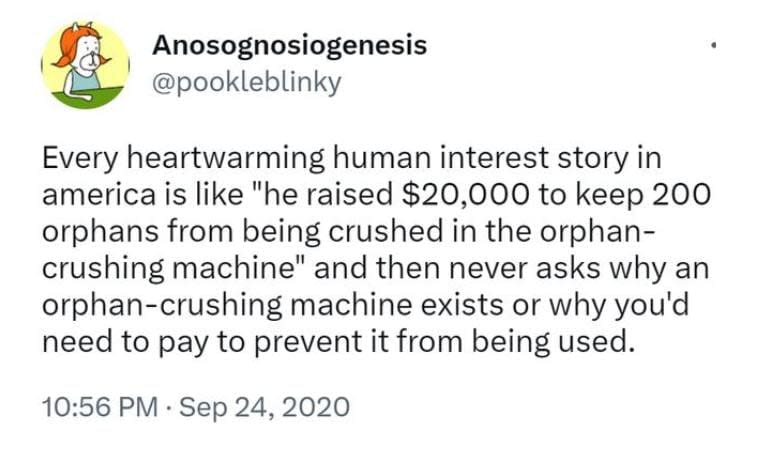
Is "rent's due in December, same as every other month" an orphan crushing machine?
Well, maybe. But let's look at this a bit more.
Is it reasonable to charge people money for housing?
We do it when people buy a home. We do it when people go on vacation and need a temporary home, a "hotel", for their vacationing time.
Apartments are living space that is somewhere between "hotel" and "home". Longer term rental living space, semi-permanent, sort of home-adjacent. Like, it's somewhere between "hotel" and "home". You see that, right?
So, if hotels are OK and homes are OK, doesn't that make apartments OK?
It would seem so, yes, very reasonable. All done? Nah, you see the wall of text below. You know it's not that easy.
Is it OK to charge people money for staying in hotels or for purchasing a home? Is that OK? We do it, as a society, but that doesn't mean it's OK. I know in the analogy above, I acted like those things were perfectly reasonable and maybe you did too. We DO them, but that doesn't make them OK. Maybe they're not OK at all. Have we checked?
People need shelter from the elements under most circumstances. They don't need it as much as they need clean drinking water or healthy food, but they do need it. Should we be charging people for this thing that they literally need to live? (A need is not a right. Yes, yes, Ayn, I do remember what you had to say about that stuff. But what are our values as a society? What should be our values? Why are we doing things and for whose benefit? These questions are important questions to ask, on an ongoing basis. And so I am asking.)
Well, as a society, we charge for other stuff people need to live. We charge money for potable water. I pay water bills to the boroughs where my apartment buildings are. Water ain't free. If you would like there to be running water with water pressure in your home, you have to pay to make that happen. (At my house, where the water comes out of the side of the mountain, someone had to pay for and install the tank to generate pressure, buy and bury the piping, the valves, the water pits, the whole system. Labor was involved at every step of the way. Ongoing maintenance is still required. Now, I do the maintenance with my brother and we do not "get paid" to do that except that we then have pressurized water in our homes but again, it is not free. Someone has to go to the hardware and buy parts. Someone has to hold a shovel and dig up/rebury pipes. I don't think of it as "free" even though there are no invoices generated or paid for the work of making water happen.)
We also charge money for food. Food is not free. Even unhealthy food is not free. As a general rule, if you would like to eat, you need to be able to pay for that food. There is some government help with buying food, but if you've ever had to depend on SNAP or WIC you know damn well that it is not a limitless cornucopia of bounty but more of a starve to death slowly state of affairs. You can't actually live on SNAP or WIC alone. It helps, but it is not enough. Churches and other organizations (private-ish, not government) run food banks to help people out. There are some resources, but there's not a robust safety net here.
Is it OK that we, as a society, have decided to charge money for these things (water, food, shelter) that all people everywhere need in order to live? Is it OK that people can thirst to death, starve to death, freeze to death if they just... don't have money?
Pause for a moment to consider and understand that money is a construct that people made out of nothing. Money didn't exist until we invented it. On a certain fundamental level, money is an idea. Heck, property, also, is an idea more than it is a real thing. We invented the idea that you could own things. The whole concept of ownership is a thing that humans invented.
We have a society built around a bunch of concepts that we invented and then we've structured things so that individual humans have to follow the rules (make or have money, spend that money for food, water, and shelter) or maybe just ... die from thirst, starvation, or lack of shelter. And we're OK with this?
I see some objections being raised in italics.
There's not enough for everybody. Money and property and stuff are systems for allocating scarce resources.
Bullshit. In the United States, a fabulously wealthy country with plentiful fresh water, arable land, and entire forests full of trees, there is 100% enough water for everyone, enough food for everyone, enough shelter for everyone. We could, if we wanted, make it so that everyone had access to clean water, healthy food, and decent shelter -- regardless of their ability to work, regardless of their ability to pay.
There is so much water in water-starved Arizona that they use big rotational sprayers to GROW GRASS FOR COWS. No, really. If you're pouring water on the ground to make grass grow, there is enough water and you're just using it stupidly.
There is enough food. The US wastes more food than you can even begin to imagine. According to the USDA, somewhere between thirty to forty percent of the food supply in the US is wasted. That is a lot of food.
If that food were given to people struggling with food insecurity, there would be no people struggling with food insecurity. Bold statement, I know, but... the USDA's own information says that in 2023, 86.5 percent of U.S. households were food secure throughout 2023. That means that 13.5% of US households were at least SOMEWHAT food-insecure. Also, as we just saw in the previous paragraph, a THIRD of the food supply is wasted.
If we can feed 86.5% of US households with 66% of the food available, simple math shows that we could feed the remaining 13.5% of households with the food that is currently being wasted. Heck, if the under-fed households ate food at roughly the same amount as the "food secure" households, they'd only need 10.3% of the food available. We could still waste of about a quarter of the food produced in the US... if, for some reason, we needed to waste food. The machine must crush orphans. If we did better at distributing the food waste to the food insecure, we could still crush orphans, just ... not as many?
There is enough shelter or there could be enough shelter for everyone. We don't use it like that, but there is enough shelter available. We just choose to use it to support a "housing market." To have a housing market, there must be unoccupied homes and empty apartments. If there are no "ready to buy" houses and no "ready to rent" apartments, then there is no housing market. And there needs to be some flexibility available in housing so that people can move around and get a bigger place when they have kids or downsize when the kids move out or whatever. If every property was occupied, all the time, by a household, then it would be very difficult for people to move for any reason at all and they'd have to arrange, like, coordinated housing swaps with other people. There would be no shopping, you'd just take whatever was available.
Do we need a housing market? Is it OK to have empty houses and vacant apartments (ready to live in) just sitting around waiting for someone to buy or rent them? Is it OK to have empty houses and vacant apartments around WHILE PEOPLE ARE LIVING IN TENTS OR UNDER BRIDGES? Is that OK?
National vacancy rates in the third quarter 2025 were 7.1 percent for rental housing and 1.2 percent for homeowner housing. This is according to the government who tracks such things. If there are vacancy rates, there might be unoccupied housing around that we could be using to house the unhoused.
How many "units" are available? 148,300,000 as of Q3 2025, according to this site. This figure lumps together rentals and houses and SROs and hotel-by-the-month arrangements where people live and everything else that might be considered a "housing unit".
How many "households" are there? There are 134,790,000 households in the US, according to this site.
So, doing some basic math, we can see that there are more "housing units" available than "households". There are 13,510,000 unoccupied housing units in the US right now. In the 2024 Point In Time study, 770,000 Americans were "homeless" at that point in time in 2024. That's a lot fewer than the empty housing units, nationwide. Like, a lot fewer.
Is it OK to have 13.5 million unoccupied housing units in this country while 770,000 people are homeless? Does that seem OK to you?
The system works well enough for most people.
Does it? And also is most people a good enough standard? Is it? Shouldn't the government be trying to serve all the people? Or a higher percentage of all the people? If we must crush orphans, do we have to crush so many?
Have you asked The Ones Who Walk Away From Omelas if "most people" is a good enough standard?
Have you asked those who are homeless if it's a good enough standard?
Have you asked your lord and savior Jesus Christ if it's good enough? (He's not my Lord and Savior, but a lotta folks claim that he's theirs while not... doing the shit he says to do. It's very confusing.) Jesus is pretty clear about what he thinks people should do. See Matthew 25:31-40:
31 When the Son of Man comes in His glory, and all the holy angels with Him, then He will sit on the throne of His glory.
32 All the nations will be gathered before Him, and He will separate them one from another, as a shepherd divides his sheep from the goats.
33 And He will set the sheep on His right hand, but the goats on the left.
34 Then the King will say to those on His right hand, ‘Come, you blessed of My Father, inherit the kingdom prepared for you from the foundation of the world:
35 for I was hungry and you gave Me food; I was thirsty and you gave Me drink; I was a stranger and you took Me in; 36 I was naked and you clothed Me; I was sick and you visited Me; I was in prison and you came to Me.’
37 “Then the righteous will answer Him, saying, ‘Lord, when did we see You hungry and feed You, or thirsty and give You drink?
38 When did we see You a stranger and take You in, or naked and clothe You?
39 Or when did we see You sick, or in prison, and come to You?’
40 And the King will answer and say to them, ‘Assuredly, I say to you, inasmuch as you did it to one of the least of these My brethren, you did it to Me.’
I mean, say what you like about herding metaphors, but that there does not lack clarity. And while shelter is not specifically mentioned, I'm pretty sure I know which way Jesus would answer if we asked him the "Should usable shelters remain unoccupied while people huddle under bridge overpasses and in tents?" question.
But yeah, the rent is due in December, same as it is every month. And my tenant K, a poster child for The Working Poor, owes part of October and all of November and all of December. He sent me $350 yesterday and a note about how he is going to get the rent caught up this month. His most-recent payment cleared up the remaining October amount owed and put him $214 to the good for November's rent.
He still owes $1382 (the remainder of November and all of December including late fees). It is December 16. There is one pay left before the close of the year. (He got paid last Friday which is why I got paid this Monday.)
Tenant K's letter, handwritten in effortful printing, emphasized that he has every intention of paying the rent, but his intentions cannot defeat the inexorable progress of numbers. In short, his math does not math.
Tenant K gets paid every other week. Judging by his prior payment schedule, he can afford to throw about $300 at the rent every paycheck. Some paychecks he can do $350, but mostly it's $300. He works as a cashier at the local Tractor Supply so I expect he gets approximately 1200 for a two-week, 40 hour week paycheck (depending on withholding).
If I were a betting woman, I'd bet that I'll get $300 or $350 right after Christmas. This will put Tenant K's debt at $1032 -- he'll owe for all of December and part of November.
January's rent of $760 is due on January 1, bringing his debt to $1792. Late fee goes on January 5, adding another $38.00 to the total due. Tenant K cannot file his tax return until January and his expected tax refund will probably not be enough to get him square though it might if he can squeeze out another chunk of payments in January while he's waiting for his tax refund.
*sigh* I would rather not evict Tenant K. He's quiet. He doesn't cause trouble. Also, it'd be nice to have someone in there heating the place over winter while I'm too busy doing the corporate taxes to work on the place. Come spring, if he hasn't gotten his shit in order, I will throw him out and find someone who can make the rent. March is the end of "pipes might freeze" season. I can string Tenant K along for his tax refund money, file on him in early February, and have him out in March.
For what it's worth, Pennsylvania is a Pay To Stay state. If Tenant K pays his rent, he gets to stay. He can pay his rent (plus applicable costs) right up until the moment the constable arrives to change the locks. And honestly, if he was paying the rent, I would not be considering how to squeeze the last dollar out of him before making him homeless. If he was paying the rent, we would not be here in the first place.
He is not paying the rent.
Maybe that's my fault? But I pay the water, sewer, and trash for the unit. I have to keep paying those bills even if the rent doesn't come in. The rent for the unit is below market rate for a two bedroom apartment and it's a decent unit that I would have no trouble renting for that amount to some other person who would pay me on the regular. The roof doesn't leak. The heating works. The fridge and stove work. All the electric is solid. There is off-street parking. It is not a shithole. The rent is also the same as it was when he moved in -- it hasn't been raised at all. This is the rent he agreed to when he signed the lease for the apartment and not an Evil Landlord Jacking The Rent problem.
The machine must crush orphans.
From knowyourmeme, we learn that an orphan crushing machine is a meme about human interest stories in America:
Is "rent's due in December, same as every other month" an orphan crushing machine?
Well, maybe. But let's look at this a bit more.
Is it reasonable to charge people money for housing?
We do it when people buy a home. We do it when people go on vacation and need a temporary home, a "hotel", for their vacationing time.
Apartments are living space that is somewhere between "hotel" and "home". Longer term rental living space, semi-permanent, sort of home-adjacent. Like, it's somewhere between "hotel" and "home". You see that, right?
So, if hotels are OK and homes are OK, doesn't that make apartments OK?
It would seem so, yes, very reasonable. All done? Nah, you see the wall of text below. You know it's not that easy.
Is it OK to charge people money for staying in hotels or for purchasing a home? Is that OK? We do it, as a society, but that doesn't mean it's OK. I know in the analogy above, I acted like those things were perfectly reasonable and maybe you did too. We DO them, but that doesn't make them OK. Maybe they're not OK at all. Have we checked?
People need shelter from the elements under most circumstances. They don't need it as much as they need clean drinking water or healthy food, but they do need it. Should we be charging people for this thing that they literally need to live? (A need is not a right. Yes, yes, Ayn, I do remember what you had to say about that stuff. But what are our values as a society? What should be our values? Why are we doing things and for whose benefit? These questions are important questions to ask, on an ongoing basis. And so I am asking.)
Well, as a society, we charge for other stuff people need to live. We charge money for potable water. I pay water bills to the boroughs where my apartment buildings are. Water ain't free. If you would like there to be running water with water pressure in your home, you have to pay to make that happen. (At my house, where the water comes out of the side of the mountain, someone had to pay for and install the tank to generate pressure, buy and bury the piping, the valves, the water pits, the whole system. Labor was involved at every step of the way. Ongoing maintenance is still required. Now, I do the maintenance with my brother and we do not "get paid" to do that except that we then have pressurized water in our homes but again, it is not free. Someone has to go to the hardware and buy parts. Someone has to hold a shovel and dig up/rebury pipes. I don't think of it as "free" even though there are no invoices generated or paid for the work of making water happen.)
We also charge money for food. Food is not free. Even unhealthy food is not free. As a general rule, if you would like to eat, you need to be able to pay for that food. There is some government help with buying food, but if you've ever had to depend on SNAP or WIC you know damn well that it is not a limitless cornucopia of bounty but more of a starve to death slowly state of affairs. You can't actually live on SNAP or WIC alone. It helps, but it is not enough. Churches and other organizations (private-ish, not government) run food banks to help people out. There are some resources, but there's not a robust safety net here.
Is it OK that we, as a society, have decided to charge money for these things (water, food, shelter) that all people everywhere need in order to live? Is it OK that people can thirst to death, starve to death, freeze to death if they just... don't have money?
Pause for a moment to consider and understand that money is a construct that people made out of nothing. Money didn't exist until we invented it. On a certain fundamental level, money is an idea. Heck, property, also, is an idea more than it is a real thing. We invented the idea that you could own things. The whole concept of ownership is a thing that humans invented.
We have a society built around a bunch of concepts that we invented and then we've structured things so that individual humans have to follow the rules (make or have money, spend that money for food, water, and shelter) or maybe just ... die from thirst, starvation, or lack of shelter. And we're OK with this?
I see some objections being raised in italics.
There's not enough for everybody. Money and property and stuff are systems for allocating scarce resources.
Bullshit. In the United States, a fabulously wealthy country with plentiful fresh water, arable land, and entire forests full of trees, there is 100% enough water for everyone, enough food for everyone, enough shelter for everyone. We could, if we wanted, make it so that everyone had access to clean water, healthy food, and decent shelter -- regardless of their ability to work, regardless of their ability to pay.
There is so much water in water-starved Arizona that they use big rotational sprayers to GROW GRASS FOR COWS. No, really. If you're pouring water on the ground to make grass grow, there is enough water and you're just using it stupidly.
There is enough food. The US wastes more food than you can even begin to imagine. According to the USDA, somewhere between thirty to forty percent of the food supply in the US is wasted. That is a lot of food.
If that food were given to people struggling with food insecurity, there would be no people struggling with food insecurity. Bold statement, I know, but... the USDA's own information says that in 2023, 86.5 percent of U.S. households were food secure throughout 2023. That means that 13.5% of US households were at least SOMEWHAT food-insecure. Also, as we just saw in the previous paragraph, a THIRD of the food supply is wasted.
If we can feed 86.5% of US households with 66% of the food available, simple math shows that we could feed the remaining 13.5% of households with the food that is currently being wasted. Heck, if the under-fed households ate food at roughly the same amount as the "food secure" households, they'd only need 10.3% of the food available. We could still waste of about a quarter of the food produced in the US... if, for some reason, we needed to waste food. The machine must crush orphans. If we did better at distributing the food waste to the food insecure, we could still crush orphans, just ... not as many?
There is enough shelter or there could be enough shelter for everyone. We don't use it like that, but there is enough shelter available. We just choose to use it to support a "housing market." To have a housing market, there must be unoccupied homes and empty apartments. If there are no "ready to buy" houses and no "ready to rent" apartments, then there is no housing market. And there needs to be some flexibility available in housing so that people can move around and get a bigger place when they have kids or downsize when the kids move out or whatever. If every property was occupied, all the time, by a household, then it would be very difficult for people to move for any reason at all and they'd have to arrange, like, coordinated housing swaps with other people. There would be no shopping, you'd just take whatever was available.
Do we need a housing market? Is it OK to have empty houses and vacant apartments (ready to live in) just sitting around waiting for someone to buy or rent them? Is it OK to have empty houses and vacant apartments around WHILE PEOPLE ARE LIVING IN TENTS OR UNDER BRIDGES? Is that OK?
National vacancy rates in the third quarter 2025 were 7.1 percent for rental housing and 1.2 percent for homeowner housing. This is according to the government who tracks such things. If there are vacancy rates, there might be unoccupied housing around that we could be using to house the unhoused.
How many "units" are available? 148,300,000 as of Q3 2025, according to this site. This figure lumps together rentals and houses and SROs and hotel-by-the-month arrangements where people live and everything else that might be considered a "housing unit".
How many "households" are there? There are 134,790,000 households in the US, according to this site.
So, doing some basic math, we can see that there are more "housing units" available than "households". There are 13,510,000 unoccupied housing units in the US right now. In the 2024 Point In Time study, 770,000 Americans were "homeless" at that point in time in 2024. That's a lot fewer than the empty housing units, nationwide. Like, a lot fewer.
Is it OK to have 13.5 million unoccupied housing units in this country while 770,000 people are homeless? Does that seem OK to you?
The system works well enough for most people.
Does it? And also is most people a good enough standard? Is it? Shouldn't the government be trying to serve all the people? Or a higher percentage of all the people? If we must crush orphans, do we have to crush so many?
Have you asked The Ones Who Walk Away From Omelas if "most people" is a good enough standard?
Have you asked those who are homeless if it's a good enough standard?
Have you asked your lord and savior Jesus Christ if it's good enough? (He's not my Lord and Savior, but a lotta folks claim that he's theirs while not... doing the shit he says to do. It's very confusing.) Jesus is pretty clear about what he thinks people should do. See Matthew 25:31-40:
31 When the Son of Man comes in His glory, and all the holy angels with Him, then He will sit on the throne of His glory.
32 All the nations will be gathered before Him, and He will separate them one from another, as a shepherd divides his sheep from the goats.
33 And He will set the sheep on His right hand, but the goats on the left.
34 Then the King will say to those on His right hand, ‘Come, you blessed of My Father, inherit the kingdom prepared for you from the foundation of the world:
35 for I was hungry and you gave Me food; I was thirsty and you gave Me drink; I was a stranger and you took Me in; 36 I was naked and you clothed Me; I was sick and you visited Me; I was in prison and you came to Me.’
37 “Then the righteous will answer Him, saying, ‘Lord, when did we see You hungry and feed You, or thirsty and give You drink?
38 When did we see You a stranger and take You in, or naked and clothe You?
39 Or when did we see You sick, or in prison, and come to You?’
40 And the King will answer and say to them, ‘Assuredly, I say to you, inasmuch as you did it to one of the least of these My brethren, you did it to Me.’
I mean, say what you like about herding metaphors, but that there does not lack clarity. And while shelter is not specifically mentioned, I'm pretty sure I know which way Jesus would answer if we asked him the "Should usable shelters remain unoccupied while people huddle under bridge overpasses and in tents?" question.
But yeah, the rent is due in December, same as it is every month. And my tenant K, a poster child for The Working Poor, owes part of October and all of November and all of December. He sent me $350 yesterday and a note about how he is going to get the rent caught up this month. His most-recent payment cleared up the remaining October amount owed and put him $214 to the good for November's rent.
He still owes $1382 (the remainder of November and all of December including late fees). It is December 16. There is one pay left before the close of the year. (He got paid last Friday which is why I got paid this Monday.)
Tenant K's letter, handwritten in effortful printing, emphasized that he has every intention of paying the rent, but his intentions cannot defeat the inexorable progress of numbers. In short, his math does not math.
Tenant K gets paid every other week. Judging by his prior payment schedule, he can afford to throw about $300 at the rent every paycheck. Some paychecks he can do $350, but mostly it's $300. He works as a cashier at the local Tractor Supply so I expect he gets approximately 1200 for a two-week, 40 hour week paycheck (depending on withholding).
If I were a betting woman, I'd bet that I'll get $300 or $350 right after Christmas. This will put Tenant K's debt at $1032 -- he'll owe for all of December and part of November.
January's rent of $760 is due on January 1, bringing his debt to $1792. Late fee goes on January 5, adding another $38.00 to the total due. Tenant K cannot file his tax return until January and his expected tax refund will probably not be enough to get him square though it might if he can squeeze out another chunk of payments in January while he's waiting for his tax refund.
*sigh* I would rather not evict Tenant K. He's quiet. He doesn't cause trouble. Also, it'd be nice to have someone in there heating the place over winter while I'm too busy doing the corporate taxes to work on the place. Come spring, if he hasn't gotten his shit in order, I will throw him out and find someone who can make the rent. March is the end of "pipes might freeze" season. I can string Tenant K along for his tax refund money, file on him in early February, and have him out in March.
For what it's worth, Pennsylvania is a Pay To Stay state. If Tenant K pays his rent, he gets to stay. He can pay his rent (plus applicable costs) right up until the moment the constable arrives to change the locks. And honestly, if he was paying the rent, I would not be considering how to squeeze the last dollar out of him before making him homeless. If he was paying the rent, we would not be here in the first place.
He is not paying the rent.
Maybe that's my fault? But I pay the water, sewer, and trash for the unit. I have to keep paying those bills even if the rent doesn't come in. The rent for the unit is below market rate for a two bedroom apartment and it's a decent unit that I would have no trouble renting for that amount to some other person who would pay me on the regular. The roof doesn't leak. The heating works. The fridge and stove work. All the electric is solid. There is off-street parking. It is not a shithole. The rent is also the same as it was when he moved in -- it hasn't been raised at all. This is the rent he agreed to when he signed the lease for the apartment and not an Evil Landlord Jacking The Rent problem.
The machine must crush orphans.


no subject
Date: 2025-12-16 06:35 pm (UTC)Same with food - I *could* presumably move somewhere where I had more land and set up a garden and grow my own food, and raise chickens for eggs and have cows for milk and cheese and potentially pigs for bacon and cull some cows and chickens for meat.
And I would be able to do it - I live in California, we have a long growing season, ALL the fruits grow here - I could have everything from oranges to grapes to apples and avocados. I think the only things I couldn't grow here would be rhubarb and bananas - not hot enough for bananas and not cold enough for rhubarb.
But - that would take ALL my time. Literally - that is a full time job, basically! Or near enough to - I am not good at it, so it probably would take all my time, LOL. And it is hard work and not particularly efficient for each person to individually grow JUST ENOUGH food for themselves (economies of scale and all that).
If I lived in another part of the country though, my food-generating options would be more limited.
So, personally, I prefer what we have - which is - OTHER PEOPLE work to produce food in all kinds of places, and there is a whole industry to package and ship it around the world so that I can go to one (or two) shops every week and pick out what looks good. Spending maybe a couple of hours a week to acquire food, vs it being ALL my time and effort.
And in exchange, I pay money for that food - because all those people and companies involved in producing the food and getting it to me - that is how they spent their time, instead of making clothing or shoes, or teaching children or being a doctor.
I can't BE all the things - I can't grow my own cotton, make thread, weave cloth, make clothing. Raise cattle, butcher and skin them, cure leather, cobble shoes.
Life is better when people are able to specialize in something, versus everyone having to muddle about trying to do everything themselves. And money as a construct, allows us to do that.
I don't subscribe to the concept that all landlords are evil - availability of rental housing, makes it possible for people to move to a new town and start a new job, and have a place to land when they get there. It makes it possible for someone to leave a bad relationship and find a new place to live reasonably easily. It gives a lot of people the ability to have a place to live, without having the responsibility of maintaining that property.
Are there problems in all of this - absolutely. Water and food and shelter are basic human necessities.
Should they be "free" - no - why should the landlord - who has mortgage and utilities and maintenance costs - be expected to keep paying for those things, if the tenant who is benefiting from them, is not paying rent?
Why should the stores who paid for the food, and pay for the costs to run the store, give the food away for free - the burden of subsidizing people in need, should not be on the individual landlords and stores and businesses. That burden should be the government's responsibility - so that the costs can be shared across the entire population, not just whichever landlord or store happens to be the one where the need is being met?
Housing costs in California are ridiculous. Food costs are going up. A big mac meal with fries and a soda at Mcdonald's is nearly $15 now. That is insane to me. Inflation is a real issues.
But I also watch - people complain about not being able to afford rent in Santa Cruz. And they are like your tenant - falling further and further behind. Twenty five years ago, when I first moved here, I met a woman who was in her mid-40s, with 3 adult children who lived with her - because they "couldn't afford" to move out.
None of them paid her any rent or contributed to any expenses. Her daughter paid for boarding a HORSE locally, instead of paying rent or any living costs.
Every year, she would fall further and further behind - she would use her credit cards to pay for day to day expenses, pay what she could every month, and at the end of the year, be 15-20K in debt. At which point, her parents would pay off her credit cards for her Christmas gift. I don't know how they managed that - we didn't get into it - but it sounded like they were cashing in her future inheritance and giving it to her now.
I was...flabbergasted. That life sounded AWFUL. Why was she still living here? Why didn't she move somewhere cheaper? Find a job that paid more? Make her kids contribute something? That just didn't seem sustainable?
But I don't see a lot of people who are willing to make significant changes to their live - move to a cheaper location etc - to improve their life? I know it's not always that simple - but doing nothing, changes nothing.
I'm not sure where I was going with all this - it's a really complex topic and I think it is a good thing to question - does the machine REALLY *need* to crush orphans? Or have we all just accepted the machine exists? Was there a good reason in the first place that we built the machine? Has it's purpose gotten corrupted over time?
no subject
Date: 2025-12-16 11:48 pm (UTC)There is something to be said for a tenant that is a known quantity for better or worse. But you might get someone else just fine in there that does pay the rent. I think you are hitting a good point with your reasoning on the whole matter.
The problem inherently is that I don't think we can just spin the ideal world out of nothing overnight by pretending reality doesn't exist. I would love to not charge someone rent or charge people for the food I grow but the reality is that I have to charge for the crops we grow because I pay for goods and services in order to grow them. I try and mitigate things by picking and donating food to the foodbank and giving discounts to people who I know are having a hard time or whatever but I still need the money to pay for everything. Gotta crush a few orphans!
How to do you radically change the world order in a way that we can do this without crushing orphans? I don't know!
no subject
Date: 2025-12-17 02:19 am (UTC)He erased his work history, and went to live on the street with nothing. Within a week he had a job. It wasn't much of a job, but it was a job. It allowed him a gym membership so he could bathe. As soon as he could he had a car. Wasn't much of a car and it didn't run particularly well well, but it was a home base and it allowed him to get a better job. And so on. The things he did and didn't do were what set him apart from the orphans that get crushed. He never tried to live above his means. He lived on the street until he had enough money to get a car, he didn't borrow money to get it. He religiously put a little bit of his earnings aside, even when it was really hard to do so and even when the amount he put aside was tiny. Within a short time he was living in an apartment and had a good bank account.
People ask me how we were able to afford to have a home in San Francisco. Part of it was luck (we bought immediately before we were priced out of the market, as in days), but part of it was dealing with money very conservatively. I absolutely refused the "balloon payment" mortgage that -everyone- urged us to take because I didn't want surprises. Two years later the market crashed and we would have lost the house if we had one of those mortgages. We have lived with roommates for 25 years, not because we wanted to, but because having a roommate brought in just enough extra that we could afford to pay the mortgage. Unexpected house expenses didn't faze us because we built in a "home repair" fund payment (to ourselves) that has covered all those costs. This is exactly the kind of strategy that allows immigrant families to get ahead. A family all lives together in a tiny, cramped space, pools their resources, educates the kids; and one by one they launch family members into better lives.
So the guy who is behind on his payment on a 2 bedroom apartment. What is he doing with that other room? If it were me, I'd have a roommate and be paying my rent on time and putting a little aside. He isn't a "crushed orphan" he is a guy who is making choices that keep him poor. He could have a roommate, move to a smaller place that he could afford, become someone else's roommate until he could afford a better place. Instead he is living with the stress of being behind and he is ruining his references.
The question we should ask is why we allow advertising to glorify the single family home and rampant consumerism. Why society doesn't teach people that they have choices about these things. The guy in the 2 bedroom apartment probably never though about taking on a roommate because it isn't part of our culture's norm. Don't even get me started about what we are doing to social structures by living in isolated little castles called single family homes...
no subject
Date: 2025-12-19 07:21 pm (UTC)Tenant K does dialysis for kidney failure (Typically three days a week and a fairly time-intensive thing, you need to bring a book or something because it's not quick.) and holds a full time job on top of being his brother's keeper.
To be completely fair, I have tenants who are totally not making what I think is... enough of an effort to manage their expenses and live within their means. The concerns you raise are valid and definitely true for some of my tenants, at least some of the time. Personal financial responsibility is a real thing and we as a whole could use more of it. I also think consumer culture has a lot to answer for on that front.
Thing is, I can't bring myself to put Tenant K. into the brought it on himself category. He is bearing up, as best he can, under a really challenging set of life circumstances while the orphan crushing machine (of which I am a component) grinds overtop of him and he is helpless to stop it.
Our orphan crushing machine has a great big loudspeaker and an endlessly looping soundtrack that blares to all and sundry that 100% of the people being crushed beneath it deserve their fate because they did not try hard enough to avoid being crushed. It's kind of loud and annoying but the machine plays it constantly for image management. If the members of a society ever realized that being crushed under the indifferent and inexorable treads of the orphan crushing machine could happen to anyone, and not just to the "deserving few" who brought it upon themselves, then then the society as a whole might feel moved to do something about the orphan crushing machine's ongoing existence. But, with continual image management, instead of people being horrified that orphans are being crushed, they say things like... "Our orphan crushing machine is OK. It's one of the good ones, not like the ones they have over in Scapegoat Foreign Country. OUR orphan crushing machine only crushes the orphans who deserve to be crushed. Lots of orphans are not crushed by our orphan crushing machine. Heck, just last week an exceptional orphan got a scholarship to The Fancy University, so it's totally #notallorphans."
no subject
Date: 2025-12-20 02:28 am (UTC)