which_chick (![[personal profile]](https://www.dreamwidth.org/img/silk/identity/user.png) which_chick) wrote2026-04-19 09:33 pm
which_chick) wrote2026-04-19 09:33 pm
which_chick) wrote2026-04-19 09:33 pm


Entry tags:
Afghan accountability in a busy weekend
There are 23 afghan squares, square 24 is in progress.
I also split all the firewood I had at the house, stacked all the firewood that was ready to stack, and hauled a bunch more firewood to the house to be ready to split. It's mostly big 'uns now. Because this shit is nontrivial sizes, moving them is something best planned carefully with a lot of attention to where my hands are, where my feet are, where the weight is. If things don't go well, I can get hurt because the log is bigger than I can honestly lift. So, proper prior planning and all that.
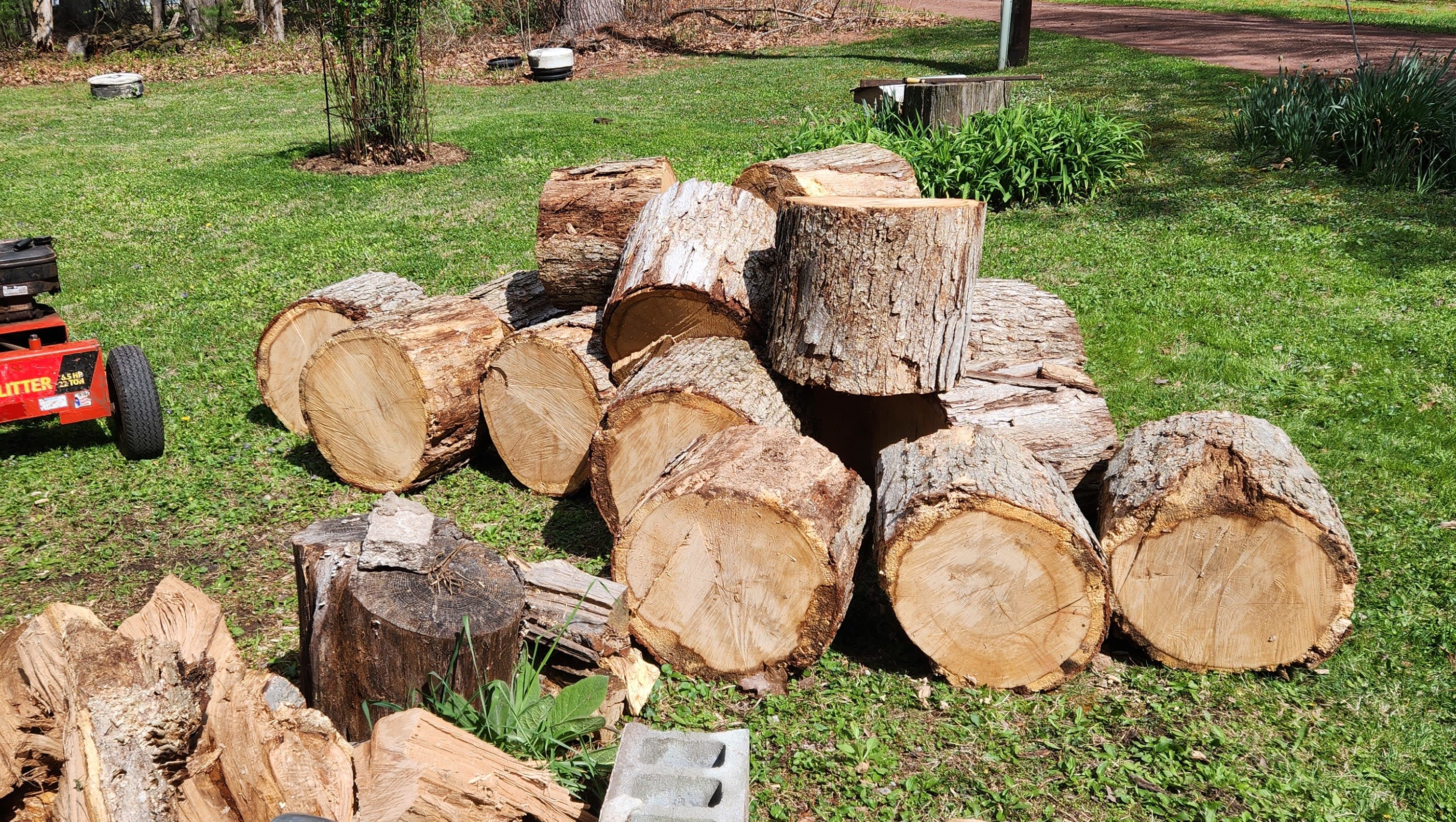
At this point, most of the white oak is out of the woods. This weekend, I loaded the non-liftable white oak rounds on the truck by way of pirate magic. (Leverage.) You upend the shortest round on end at the very edge of the road. (The non-road is about 4" higher than the road.) Non-road surface + shortest round on end makes the top of the shortest round about 6" below the truck (Ford Ranger) tailgate. As the rounds were 18"+ in diameter, I could flop a log so that the cut end was partly resting on the upper corner of the "shortest round". Then, I levered it up on top of shortest round, so that the two logs were stacked, cut surface to cut surface. Then, I flopped the log again so that the cut end was partly resting on the truck tailgate. From there, I could lever it into the truck. (The lever is the log itself. Because the log is always resting on a support of some kind, I'm never actually lifting the whole entire log at any time. It's more of a supported tipping effort.) This style of thing allowed me to load most of the white oak trunk pieces, though of course shortest round is still by the road because I didn't have a way to load it. I'll get to it later.
Unloading was just rolling them off the bed of the truck into the yard. Nice. Here's a picture:
Then I started on the red oak, which is greener (still dead, but the wood is wetter) and bigger so... heavier. I don't have a hope in hell of levering these onto the truck. The leverage thing gives me some advantage, but not that much. Nah, fam. I can roll them and tip them, but that's about it.
So I hauled the splitter to the red oak and parked it there alongside and tipped it up (so that the log-to-be-split does not have to be lifted off the ground) and split the rounds into liftable (with effort) quarters. I hauled them to the house and stacked them for later. The quarters will need to be made into log-sized pieces at a later date but for now they're stacked and ready for splitting. Here's a picture of them, and you can see that they're not small logs by comparing them to the normal-sized logs stacked just behind them:
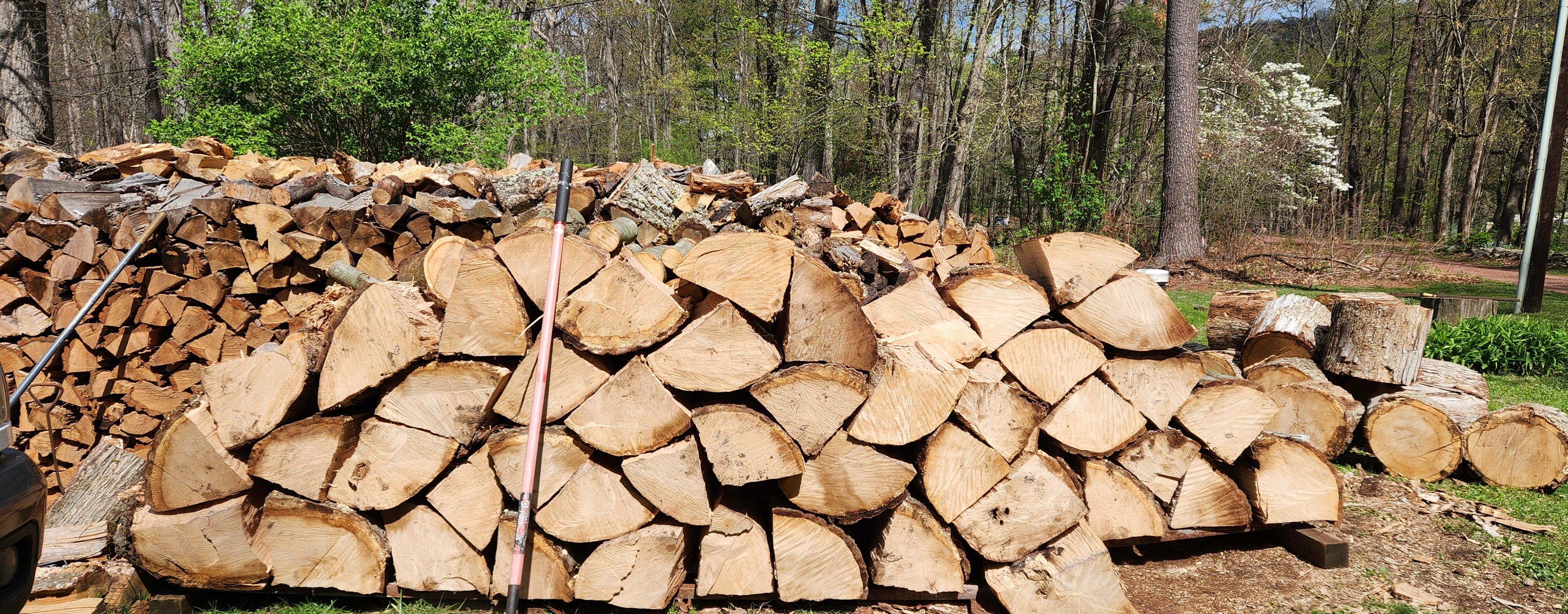
About two-thirds of the red oak trunk is still in the woods, some bigger and some smaller. I started kinda in the middle, but I do expect to be able to get all the rounds split... with some effort.
Why don't you just cut smaller trees?
These were close to the road and uphill from the road and already dead. They were oak, which I like to work with. They were forest-grown so there is a shitton of straight beautiful trunk that will split like a boss and make nice straight pieces that will stack well.
For what it's worth, I do have a bucket loader. I could have gone and got the tractor and used that to haul the logs to my house.
However, using machinery tears up the soft, spring ground. I don't like to do that if I can avoid it.
Using a bucket loader does not help me get in my hour a day of sweat-producing exercise in the same way that wrestling the logs by hand does.
The bucket loader does not engage all the muscles in my body.
Firewood is about getting wood and having heat for the 27-28 winter. It's also about doing physical labor, moving heavy things, working up a sweat. I'm not going to go to a gym. That isn't something I do. I will play firewood, though.
Oh, and I measured the woodpile for folks who had asked. The woodpile is 24' long and approximately 4'6" high (not including the poles and stuff that I stack the wood on, this is just the actual firewood height). Each stack is a nominal 16" wide and there are 4 stacks.
Can I math this into "cords" which is the only legal denomination of firewood to be sold in Pennsylvania? (In my state, it's illegal to sell fire wood by "the pickup load" or "the triaxle load" or anything like that. It has to be "by the cord" or fraction thereof. This is bullshit and everybody fucking ignores it.)
Yes. A cord is 4' wide, 4' high, and 8' long or 128 cubic feet of wood. So, I can totally find out how many cords I've got in my standard, fully-stocked woodpile.
24' x 4.5' high x 1.333' wide = 144 cubic feet of wood. I have four of those, so 144 x 4= 576 cubic feet of wood.
To get cords, we divide by 128: 4.5 cords of wood in the fully-stocked woodpile.
For what it's worth, I've never actually met a cord of wood. That's not an amount I'm familiar with.
I also mowed the lawn for the first time this year, helped brother-the-elder get horse poop for his garden, and spent an hour and a half pulling out barberry. It was a pretty busy weekend, all told.
I also split all the firewood I had at the house, stacked all the firewood that was ready to stack, and hauled a bunch more firewood to the house to be ready to split. It's mostly big 'uns now. Because this shit is nontrivial sizes, moving them is something best planned carefully with a lot of attention to where my hands are, where my feet are, where the weight is. If things don't go well, I can get hurt because the log is bigger than I can honestly lift. So, proper prior planning and all that.
At this point, most of the white oak is out of the woods. This weekend, I loaded the non-liftable white oak rounds on the truck by way of pirate magic. (Leverage.) You upend the shortest round on end at the very edge of the road. (The non-road is about 4" higher than the road.) Non-road surface + shortest round on end makes the top of the shortest round about 6" below the truck (Ford Ranger) tailgate. As the rounds were 18"+ in diameter, I could flop a log so that the cut end was partly resting on the upper corner of the "shortest round". Then, I levered it up on top of shortest round, so that the two logs were stacked, cut surface to cut surface. Then, I flopped the log again so that the cut end was partly resting on the truck tailgate. From there, I could lever it into the truck. (The lever is the log itself. Because the log is always resting on a support of some kind, I'm never actually lifting the whole entire log at any time. It's more of a supported tipping effort.) This style of thing allowed me to load most of the white oak trunk pieces, though of course shortest round is still by the road because I didn't have a way to load it. I'll get to it later.
Unloading was just rolling them off the bed of the truck into the yard. Nice. Here's a picture:
Then I started on the red oak, which is greener (still dead, but the wood is wetter) and bigger so... heavier. I don't have a hope in hell of levering these onto the truck. The leverage thing gives me some advantage, but not that much. Nah, fam. I can roll them and tip them, but that's about it.
So I hauled the splitter to the red oak and parked it there alongside and tipped it up (so that the log-to-be-split does not have to be lifted off the ground) and split the rounds into liftable (with effort) quarters. I hauled them to the house and stacked them for later. The quarters will need to be made into log-sized pieces at a later date but for now they're stacked and ready for splitting. Here's a picture of them, and you can see that they're not small logs by comparing them to the normal-sized logs stacked just behind them:
About two-thirds of the red oak trunk is still in the woods, some bigger and some smaller. I started kinda in the middle, but I do expect to be able to get all the rounds split... with some effort.
Why don't you just cut smaller trees?
These were close to the road and uphill from the road and already dead. They were oak, which I like to work with. They were forest-grown so there is a shitton of straight beautiful trunk that will split like a boss and make nice straight pieces that will stack well.
For what it's worth, I do have a bucket loader. I could have gone and got the tractor and used that to haul the logs to my house.
However, using machinery tears up the soft, spring ground. I don't like to do that if I can avoid it.
Using a bucket loader does not help me get in my hour a day of sweat-producing exercise in the same way that wrestling the logs by hand does.
The bucket loader does not engage all the muscles in my body.
Firewood is about getting wood and having heat for the 27-28 winter. It's also about doing physical labor, moving heavy things, working up a sweat. I'm not going to go to a gym. That isn't something I do. I will play firewood, though.
Oh, and I measured the woodpile for folks who had asked. The woodpile is 24' long and approximately 4'6" high (not including the poles and stuff that I stack the wood on, this is just the actual firewood height). Each stack is a nominal 16" wide and there are 4 stacks.
Can I math this into "cords" which is the only legal denomination of firewood to be sold in Pennsylvania? (In my state, it's illegal to sell fire wood by "the pickup load" or "the triaxle load" or anything like that. It has to be "by the cord" or fraction thereof. This is bullshit and everybody fucking ignores it.)
Yes. A cord is 4' wide, 4' high, and 8' long or 128 cubic feet of wood. So, I can totally find out how many cords I've got in my standard, fully-stocked woodpile.
24' x 4.5' high x 1.333' wide = 144 cubic feet of wood. I have four of those, so 144 x 4= 576 cubic feet of wood.
To get cords, we divide by 128: 4.5 cords of wood in the fully-stocked woodpile.
For what it's worth, I've never actually met a cord of wood. That's not an amount I'm familiar with.
I also mowed the lawn for the first time this year, helped brother-the-elder get horse poop for his garden, and spent an hour and a half pulling out barberry. It was a pretty busy weekend, all told.